 Skip to content
Summarize with
Lock installation and repair involve the setup of new hardware or the restoration of existing security mechanisms to ensure a property remains secure. Effective lock installation services involve selecting the correct hardware grade for the door type and ensuring the strike plate aligns perfectly with the bolt. Lock repair services address common issues such as jammed cylinders, broken keys, or loose handles by cleaning internal parts or replacing worn pins. Maintaining functional hardware prevents unauthorized entry and extends the life of the door assembly.
This guide details the technical requirements and practical considerations for maintaining door security. Integrity Key Lock & Safe of Texas offers these insights based on extensive field experience managing residential and commercial security hardware. Understanding the mechanics of door lock installation helps property owners make informed decisions about their safety requirements.
Differences Between Installation and Repair
Deciding between lock installation and repair depends on the condition of the existing hardware and the security goals of the property owner. Professional locksmith lock services usually start with an assessment of the internal components. If the lock body remains intact but the key no longer turns easily, a repair or a simple re-keying process often suffices. Re-keying involves changing the internal pins so a new key works while the old one does not.
New installation is the primary choice when moving into a new property, upgrading to smart technology, or replacing hardware that has suffered physical damage. Repair, conversely, is more cost-effective for high-quality vintage locks or minor mechanical issues like a sagging lever.
Technical Standards for Hardware
The quality of lock hardware is measured by standards established by the Builders Hardware Manufacturers Association. These grades help consumers understand how much force a lock can withstand and how many cycles it can complete before failing.
| Feature | Grade 1 (Heavy Duty) | Grade 2 (Standard) | Grade 3 (Residential) |
|---|---|---|---|
| Primary Use | Commercial / High Security | Light Commercial / Residential | Basic Residential |
| Cycle Test | 800,000 to 1,000,000 cycles | 400,000 cycles | 200,000 cycles |
| Strike Impact | 10 blows of 75 foot-pounds | 5 blows of 75 foot-pounds | 2 blows of 75 foot-pounds |
| Bolt Projection | 1 Inch | 1 Inch | 1 Inch |
Selecting the right grade during lock installation services ensures the hardware matches the expected traffic and risk level of the building.
Common Lock Repair Services
Mechanical locks face constant friction and environmental stress. A frequent issue is the misalignment of the door and the frame. If a door settles, the deadbolt may not line up with the strike plate hole. Repairing this often requires adjusting the hinges or moving the strike plate rather than replacing the lock itself.
Another common repair involves the cylinder. Over time, dust and debris build up inside the keyway. This causes the pins to stick, making it difficult to insert or turn the key. A technician can often resolve this by cleaning the cylinder with specialized non-oily lubricants.
Bonus Tip: Avoid using thick oils or WD-40 inside a lock cylinder. These products attract dust and eventually create a sticky residue that causes the lock to fail. Dry graphite or specialized silicone-based lubricants are better for long-term maintenance.
The Process of Door Lock Installation
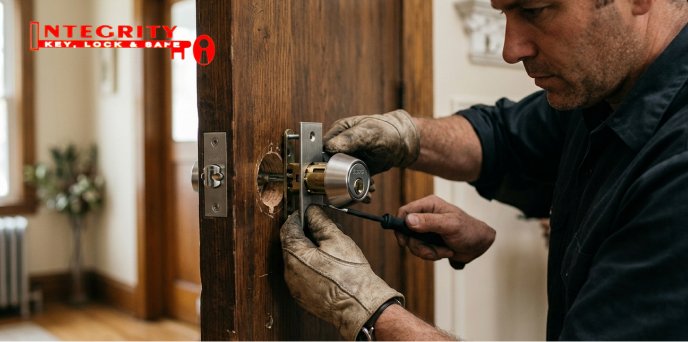
Proper door lock installation requires precision. Even a high-security lock fails if it is not installed correctly. The process begins with measuring the backset, which is the distance from the edge of the door to the center of the hole drilled for the lock. Most residential doors use a backset of 2 3/8 inches or 2 3/4 inches.
Once the holes are prepared, the technician installs the latch or bolt into the door edge. The exterior and interior trim pieces are then connected through the door. The final step involves the strike plate installation on the door frame. If the strike plate is not secured with long screws that reach the wall stud, the door remains vulnerable to being kicked in.
Market Trends in Security Hardware
The demand for advanced locking systems continues to grow. According to data from Fortune Business Insights, the residential security market is expanding as more people adopt smart home technologies. This shift has changed the nature of lock installation and repair, as technicians now deal with electronic components and software integration alongside traditional mechanics.
Reports from IBISWorld indicate that the locksmith industry remains a stable sector of the economy due to the constant need for property maintenance and emergency lockout assistance. Property owners are increasingly looking for locksmith lock services that combine traditional physical security with modern digital access control.
Things to Consider Before Making a Decision
Before choosing between lock installation and repair, evaluate the following factors:
- Age of Hardware: If a lock is over 15 years old, internal wear might make a repair temporary. Replacement is often more reliable.
- Frequency of Use: High-traffic doors, such as a main storefront or a back door used by a large family, require higher-grade hardware.
- Weather Exposure: Locks on gates or exterior doors facing harsh sun or rain need weather-resistant finishes and internal seals.
- Existing Damage: If a door was previously pried or kicked, the wood around the lock might be weak. In this case, installing a wrap-around plate or a new door may be necessary.
Bonus Tip: When installing electronic smart locks, always check the batteries every six months. Most smart locks have an external emergency power contact or a physical key override to prevent lockouts during a power failure.
Common Questions About Lock Services
Is it better to re-key or replace locks?
Re-keying is a fast, budget-friendly option if the hardware is structurally sound. It modifies the internal pin configuration to invalidate old keys. You should replace the lock entirely if you require a higher security rating, a different aesthetic finish, or updated hardware functionality.
How long does a standard installation take?
A standard deadbolt or knob installation usually takes 20 to 30 minutes per door if the holes are already drilled. Fresh installations on new doors may take 45 to 60 minutes.
Can a broken key be removed without replacing the lock?
Yes. Professional tools called key extractors can usually pull a broken fragment out of the cylinder. Once the piece is removed, a technician can often cut a new key using the broken pieces as a template.
Expert Answers to Security Needs
What are the signs that a lock needs immediate repair?
Difficulty turning the key, a loose or “spinning” cylinder, and a handle that does not spring back to its original position are clear indicators of mechanical failure. Ignoring these signs often leads to a total lockout.
Does a smart lock provide more security than a traditional lock?
Smart locks offer convenience and tracking features, but their physical security depends on the grade of the deadbolt used. A Grade 1 traditional deadbolt is physically stronger than a Grade 3 smart lock.
Why is the strike plate so important?
The strike plate is the metal piece on the door frame where the bolt sits. Using three-inch screws to anchor the strike plate into the wooden wall framing significantly increases the resistance of the door against forced entry.
Can a locksmith fix a lock that has been painted over?
Layers of paint can clog the bolt and the internal mechanism. While a technician can often clean and restore the lock, it usually requires complete disassembly and a chemical cleaning of the parts.
Final Thoughts on Lock Maintenance
Maintaining the security of a property requires attention to the functional state of all entry points. Professional lock installation and repair ensure that hardware operates smoothly and provides the intended level of protection. Choosing high-quality ANSI-graded hardware and performing regular maintenance like lubrication can prevent unexpected failures. Property owners should assess their hardware annually to identify signs of wear or misalignment before they become security risks.
Reliable Security Solutions
Integrity Key Lock & Safe of Texas provides specialized knowledge in residential and commercial hardware. For technical assistance or inquiries about specific security setups, contact the office at (830) 868-8608 or send an email to clark@integritykeytexas.com. Professional guidance helps ensure that every door lock installation meets safety standards and provides long-term reliability for your property.
Sources
- Builders Hardware Manufacturers Association – Detailed information on the grading system for residential and commercial lock hardware.
- Fortune Business Insights – Market research regarding the growth and trends of the residential security industry.
- IBISWorld – Economic data and industry analysis for locksmith services in the United States.
